Written by Toby Philpott w/ Artwork by Bobby Campbell
“riverrun, past Eve and Adam’s, from swerve of shore to bend of bay, brings us by a commodius vicus of recirculation back to Howth Castle and Environs.”
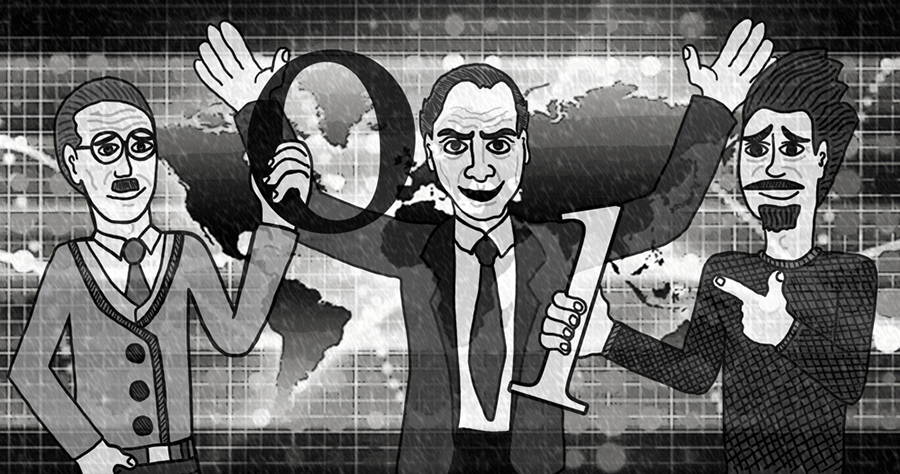
 We learned many wonderful things on RAW‘s Tale of the Tribe course, but Giambattista Vico’s holistic view of human evolution and development as a cyclic progression, a spiral, really appealed to many of us and deserves further exploration. In spite of living in dangerous times for such thinking Vico perceived, and attempted to describe, history as a whole system, and humans as self-made, just as Darwin would later attempt to sum up how plants and animals formed themselves without a “creator”.
Moderns might describe Joyce’s fantastic novel Finnegans Wake (which implied this cyclic structure) as a hologram, but Vico might well have described it in the Hermetic or alchemical terms of a Microcosm/Macrocosm, “as above, so below.”
BABABADLGHARAGHTAKAMMINARRONN
KONNBRONNTONNERRONNTUONNTHUNN
TROVARRHOUNAWNSKAWNTOOHOOHOOR
DENENTHURNUK!
This 100 letter magical word appears on page one and some say it represents a clap of thunder, the Big Bang of Creation. To me it would work equally well as the sound of a slapstick fall (Finnegan falling off his ladder like a ton of bricks) – and, as the main character has fallen asleep, perhaps it could also remind us of a very loud snore.
The Gnostics seemed to think of The Fall (and the Original Sin) not as a human flaw – Adam eating the Forbidden Fruit – so much as something that “god” did. A demiurge fell for the temptation to slow Light down into Matter, to manifest Himself in the blissful void of the Great Mother, to create a world to rule over, and condemn people to a life and death struggle, etc. Confused echoes of this remain in the stories of Fallen Angels bringing humans fire and teaching the arts of civilisation, leading to the loss of an innocent life.
Vico worked with the Inquisition breathing down his neck, so he could not talk of an eternal cycle with no beginning, and had to start from the Creation in Genesis. He implied that after the Flood Noah’s descendants wandered for some time, losing their god-given culture and language and degenerating to a bestial life. (Without that pressure to fit the story to The Bible story, we just start with “cave-men” these days, and already know about ancient civilisations rising, flourishing and then falling).
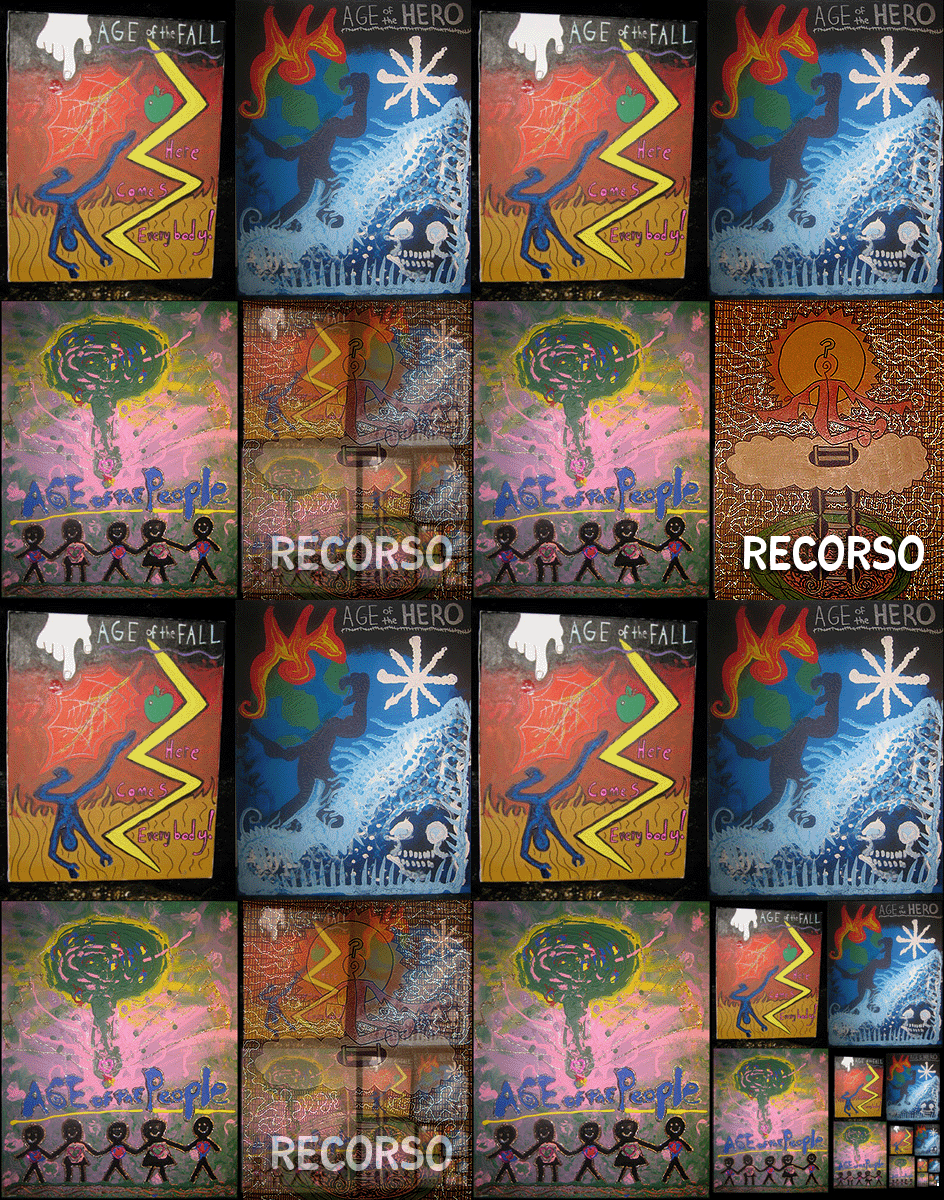
 Vico chose to start his description of the cycle with primitive humans immersed in nature, using only a symbolic language of gesture, monosyllables, signs, hieroglyphs and ideograms to describe their experience of the world. Deeply embedded, they viewed the world in a mythic sense, and felt themselves as part of the whole rather than as separate individuals. He thought that they would hold the elements in awe. Storms and the voice of the thunder would impress them greatly, and lightning snaking down might bring them fire with which they could keep warm while huddled in their caves. In the face of such “gods” those brute humans covered themselves with fur, and guiltily retreating to the privacy of caves (a recap of Adam and Eve cowering from God’s thunderous anger at their disobedience) so beginning the forming of human culture. The strong alpha males offered protection from predators, outlaws and other threats to the older or weaker, and to their families of women and children. Even if they seemed like giants, ritual may have proved necessary against these greater forces of nature, placating the “gods” and protecting the clan. Primitive religion thrives in the Age of the Fall…
 As humans began to build shelters, cities, palaces and churches – develop communities and take up farming – they moved into what he called the Age of Heroes.
They gained more control over the elements, and the powerful either fought or joined in alliances, employing and ruling the poorer and weaker. Pharaohs, Kings and Queens appeared as demi-gods – a manifestation of an unseen deity. Laws, institutions, and rigid beliefs developed to control society. Their language became polysyllabic, and poetic – with the use of metaphor and simile – but few would understand this complex language – much of it remained a mysterious tool in the hands of the Priests and rulers. Rich families would have heraldic crests, flags, and other signs of power. Rules of chivalry and Romance (falling in love) might hold sway, but the social structure kept sharp divisions between rich and poor, as in feudal economies.
 When the laws get applied fairly to all they inevitably restrict the abuse of power, and even the rich have to acknowledge and obey them, so gradually the use of logic and articulate common language leads to abstraction, generalization, free discussion, legal argument and rationality. Rigid, traditional values get challenged by a meritocracy and eventually this leads the way to “democracy”.
In the Age of the People all have similar rights, although freedom can feel frightening…
 This stage, too cannot last, and Vico thought of the next stage (which he called the Ricorso) as a period of confusion and anarchy and self-indulgence. This could pave the way for a return to barbarism, a new upsurge of superstition, a neo-primitive phase, the resurgence of religion in all its forms, and a yearning once more for certainty, and the worship of a strong male authority figure, aka God.
Just as Joyce had written Ulysses to contain all the stories and struggles of humans manifest in one brief day in Dublin, portrayed by ordinary folk, so he structured Finnegans Wake as one long night, with several cycles of sleep and dreaming.
A falling asleep, a dreaming of all the tales of the tribe in all the languages of the world, an endless repetition of human relationships – marriage and a family ruled by the male in the age of gods, the fighting of brothers and the wiles of daughters in the age of heroes, the burial of the father in the age of the people – finally returning to consciousness at the break of day, to start the whole thing over.
We can see the Rise and Fall of the Roman Empire in Vico’s model, and we can see the Roman Catholic Church giving way to Feudal England, followed by the rational Enlightenment, etc. Many people adopted the cyclic theory of history. Marx liked the inevitability he saw implied in the class struggle of the weak to demand and win their rights. He overlooked the fact that we cannot stop at any one phase of the cycle, so the reversion to autocratic Stalinism from the initially “rational” Communism might have disappointed him if he had lived to witness it. Of course, many of us may relish this anarchic period of confusion – but this model stands as a warning of the risks as time rolls on…and a Fundamentalist religious mentality kicks in.
Perhaps we can learn to control how long each part of the cycle lasts? Perhaps McLuhan’s prediction of an oral/aural, post-literate, mythopoetic tribe shows one way that we could pass through the current age of change and movement and turbulence and opportunity to enter a mythical and wondrous ‘golden age of the gods’ , with every man and woman a star, without this time Falling for a Father Figure?

“As his title indicates (FINNEGANS WAKE), he saw that the wake of human progress can disappear again into the night of sacral or auditory man. The Finn cycle of tribal institutions can return in the electric age, but if again, then let’s make it a wake or awake or both. Joyce could see no advantage in our remaining locked up in each cultural cycle as in a trance or dream. He discovered the means of living simultaneously in all cultural modes while quite conscious. The means he cites for such self-awareness and correction of cultural bias is his “collideorscope”. This term indicates the interplay in colloidal mixture of all components of human technology as they extend our senses and shift their ratios in the social kaleidoscope of cultural clash: “deor”, savage, the oral or sacral; “scope” the visual or profane and civilized.”
-Marshall McLuhan
And Joyce felt tempted, god-like, to finally write his own sacred text, his last creation.
Here endeth the first lesson.
“The keys to. Given! A way a lone a last a loved a long the…”